The last few months have been interesting for Twitter.
After years of no innovation at all, Twitter is making big product changes. It has acquired Breaker and Revue, and presumably has more M&A coming. It’s coming out with Spaces. The only thing it clearly isn’t working on is an edit button.
The core idea is that Twitter is doubling down on multichannel engagement for creators so that they never have to leave for anywhere else.
Strategically, though, what is a microblogging service doing buying a social podcasting company and a newsletter tool while also building a live broadcasting sub-app? Is there even a strategy at all?
I humbly propose this: There is a strategy. Twitter is trying to revitalize itself by adding more contexts for discourse to its repertoire. The result, if everything goes right, will be an influence superapp that hasn’t existed anywhere before. The alternative is nothing less than the destruction of Twitter into a link-forwarding service.
Let’s talk about how Twitter is trying to eat the public conversation.
Why now?
Twitter’s problem is pretty simple. It’s this.
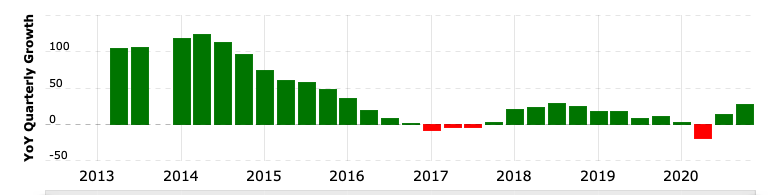
Twitter revenue quarterly growth 2013-21. Image Credits: Macrotrends
Another way of putting it is: Twitter is not generating as much money from ads as it used to. Ad revenue has failed to grow because Twitter is generally considered to have a poorly performing product for marketers. As a result, its stock price has been flat for years.
The irony, though, is that Twitter became more socially important during this period of financial stagnation to the point that the president of the United States nearly launched several wars on the platform!
The core reason is that since becoming a public company, Twitter has been considered by most to be one of the most boring tech companies productwise. Yes, people joke about the lack of an edit button, but the platform really has been slow to innovate in any real way.
Twitter was one of the most dynamic companies around, going from the fail whale company to being the company that invented the hashtag and acquiring some of the hottest companies, from Periscope to Vine.
But it all failed. Twitter rarely used acquisitions successfully. It stopped putting out new features and barely even managed simple improvements. Despite describing itself as “what’s happening now,” it missed every boat. Until this year.
What changed?
- Twitter started to face its first real competition in years due to the social media renaissance. Twitter’s strength has always come from being where the news happens. Podcasts, Clubhouse, newsletters and other new channels are true competitive threats.