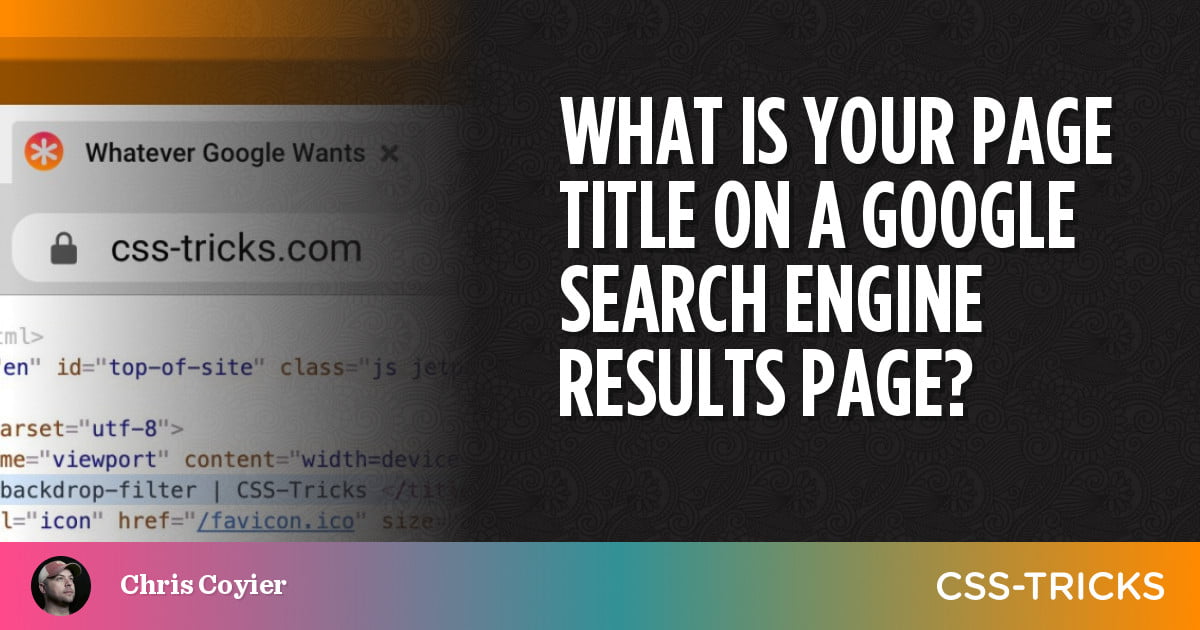
Whatever Google wants it to be. I always thought it was exactly what your <title> element was. Perhaps in lieu of that, what the first <h1> on the page is. But recently I noticed some pages on this site that were showing a title on pic.twitter.com/xzoPcge9nT
— Chris Coyier (@chriscoyier) August 20, 2021
The thread has more info than what unfurled here.
This is a known thing. Apparently, they’ve been doing this for a long time (~10 years), but it’s the first I’ve noticed it. And it’s undergone a recent change:
The article is pretty clear about things:
[…] we think our new system is producing titles that work better for documents overall, to describe what they are about, regardless of the particular query.
Also, while we’ve gone beyond HTML text to create titles for over a decade, our new system is making even more use of such text. In particular, we are making use of text that humans can visually see when they arrive at a web page. We consider the main visual title or headline shown on a page, content that site owners often place within <H1> tags or other header tags, and content that’s large and prominent through the use of style treatments.
Other text contained in the page might be considered, as might be text within links that point at pages.
The change is in response to people having sucky <title> text. Like it’s too long, too jacked up with SEO garbage (irony!), or are just plain non-descriptive.
I’m not entirely sure how much I care just yet.
Part of me thinks, well, google.com isn’t the web. As important as it is, it’s a proprietary product by a private company and they can do whatever they want within the bounds of the law. In this case, it’s clear the intention is to help: to provide titles that are more clear than what the original page has.
Part of me thinks, well, that sucks that, as site owners, we have no control. If Google wanted to change the AMP. AMP was basically saying, “Y’all are absolutely horrible at building performant mobile websites, so we’re going to build a strict set of rules such that you can’t screw it up anymore, and dangling a carrot of better SERP placement if you buy into the rules.” This way of creating page titles is basically saying, “Y’all are absolutely horrible at providing good titles, so we’re going to title your pages for you so you can’t screw it up anymore and we can improve our SERPs.”
Except with AMP, you had to put in the development hours to make it happen. It was opt-in, even if the carrot was un-ignorable by content companies. This doesn’t carry the risk of burning development hours, but it’s also not something we get to opt into.