Is your business suffering from low productivity? Poor processes and a lack of suitable technology may be huge contributing factors that, in turn, cause your company to deal with low-performance indicators.
An antiquated legacy application may not provide the visibility you need. If you’re refusing to switch to a sustainable ERP system, then that is likely a part of your problem. Many companies have an attitude of “if it’s not broke, don’t fix it,” but that mentality will only hold your company back from success.
76% of managers agree that companies need to radically reengineer the experiences, bringing people and technology together in a more human-centric way. (Accenture)
The hallmark of any thriving business is to assess its current state and have a better plan to grow profits and optimally operate. The conservative approach of not revamping your existing business applications and moving to a newer ERP system may be holding your company back from its true growth potential. You need to reassess your legacy processes based on different attributes, such as:
- Productivity
- Employee engagement
- Overall cost savings
- Operational efficiency
- Process management
- People management
- Overall performance
We will touch upon these points in a later article. For this article, let’s look at different aspects that will help handle your ERP conversion in a better way.
What are some preparatory steps for an ERP implementation?
Creating a budget for the ERP implementation – It’s essential to know your budget before you spend. Knowing what features you need and the spending associated with them, helps you choose the right solution for your company.
Identification of the right ERP system – Budgeting is one thing. Identifying an ERP system that fulfills your company’s short-term and long-term goals is another. There is always a delicate balance between price and growth prospects on a technology platform. That is where the ROI calculation comes in handy. You can be more aware of the spending involved with the right tools, even if it means more short-term investments that yield long-term gains. To understand the right ERP system, make a matrix of competing systems with different attributes, such as increased productivity, higher visibility, streamlined operations, etc.
Identification of a systems specialist with ERP transformation expertise – Shop for systems integrators, who have done this many times and know the pitfalls and methods of handling an ERP transformation. Try not to do the transformation yourself unless you have a team that has always done ERP transformations as a living. To use an analogy, you let a qualified builder build your house unless you have a lot of time and money to spend on making mistakes trying to do it yourself.
Choosing an internal champion to spearhead the transformation – If you want the ERP deployment to go well, you need an internal champion, who will be part of the transformation. The role of an internal champion is to understand the future state, make those necessary negotiations with the users on the solution, and be part of the process from start to finish. This individual then takes over the management of the application moving forward.
The right superuser group – The superuser group contributes toward requirements, design, and user acceptance testing. The right people know their respective functions well enough to participate in the required gathering and design. They also will be those who use the system as it is being built and once the final solution is ready for testing.
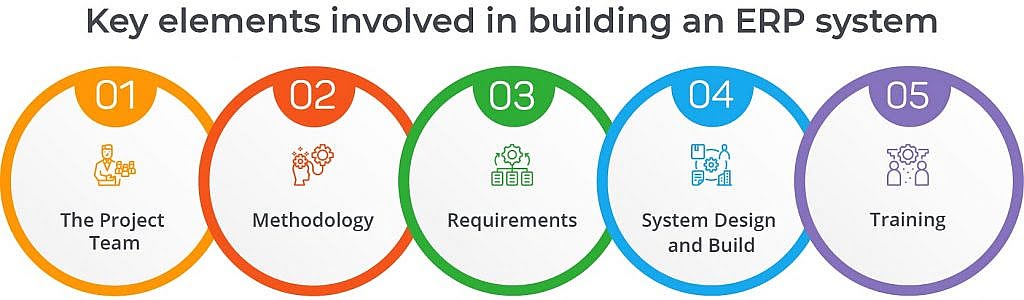
Some key elements involved in building an ERP system
The project team
The project team comprises sponsors, internal IT/ business relationship managers, superusers, and systems integrators. This team will be responsible for the transformation and involved in all phases of the project. The internal champions, who take on the role of change agents, influence the company users to move toward new solutions and must not get in the old ways of working. These champions not only understand the solutions but also bridge the gap between the present (as-is state) and the future (to-be state).
Methodology
Businesses that do not leverage a proper approach to an ERP conversion, hinder project completion. An ERP system conversion requires a structured deployment procedure to ensure the project stays on track. Without a structured methodology, you may spend more on an ERP implementation than expected. Without structure, if the process breaks down, cost tracking can become a challenge and the use cases that surface can turn into customizations. A reliable transformation procedure includes tracking risks related to people, processes, or regulations, and it allows a delicate balance between accommodating must-have vs. nice-to-have requirements.
Requirements
It sounds simple, but it is essential to freeze the project scope and capture the project requirements accurately when producing a solution. When the project team cannot capture high-level and detailed requirements, the project scope is not concrete. Every conference room pilot will surface delta requirements and use cases to analyze. Have deep-dive sessions to go over the different user scenarios in each functional area early on.
System Design and Build
When it comes to system design, it’s essential to have a clear starting point. I call it the starter pack by industry, which provides you with a starting point to run your first conference room pilot (CRP), where the project team can showcase the base system. During the CRP, you get the opportunity to dive into additional details of a scenario, where those oddball situations start surfacing.
The implementation team often works toward the to-be state while the user groups fixate on the current system. Those little flexibilities that your current system may have could be eliminated in the new system due to industry best practices for managing data integrity in the system. As you run through multiple rounds of CRPs, you will understand how to progress to the future state and what processes to re-engineer as part of the design.
Training
Once the project team has designed and built the system, sufficient training is required to ensure that users can confidently use the system and follow the process per the agreed design. The more the end-users train, the better they become at handling the system.
“…an average of 53 percent of employees have been trained in new digital and analytics capabilities since their transformations…”
You will notice that, initially, your end users may have difficulty using the system and feel frustrated that they need someone’s help in order to move forward. To help combat this, split your training plan to accommodate two levels of comfort in using new systems: a basic level 2 user group, which have difficulty using newer systems, and an advanced level 1 group, who is nimble with newer and more sophisticated applications. Encourage the level 1 group to show more optimism about using the new system, which may help the level 2 group adapt to the new ERP system more readily.
Final Thoughts
As you get ready to move forward, here are some questions to ask yourself:
- Are there significant reasons for the persistent problems in operations?
- What are the substantial issues that slow you down from operating at full speed?
- Did you notice a downward curve in your company’s growth rate?
- Have your competitors made rapid changes to move forward?