Raw Chromium, perhaps?
So, Chrome is based on Chromium which is open-source. Chrome is Chromium with Google’s extra stuff on top of it. What extra stuff? Kinda lots! A few years ago, The Verge published “Microsoft reveals all the Google things it removed in its Chromium Edge browser” with this image from Microsoft listing out all the stuff:
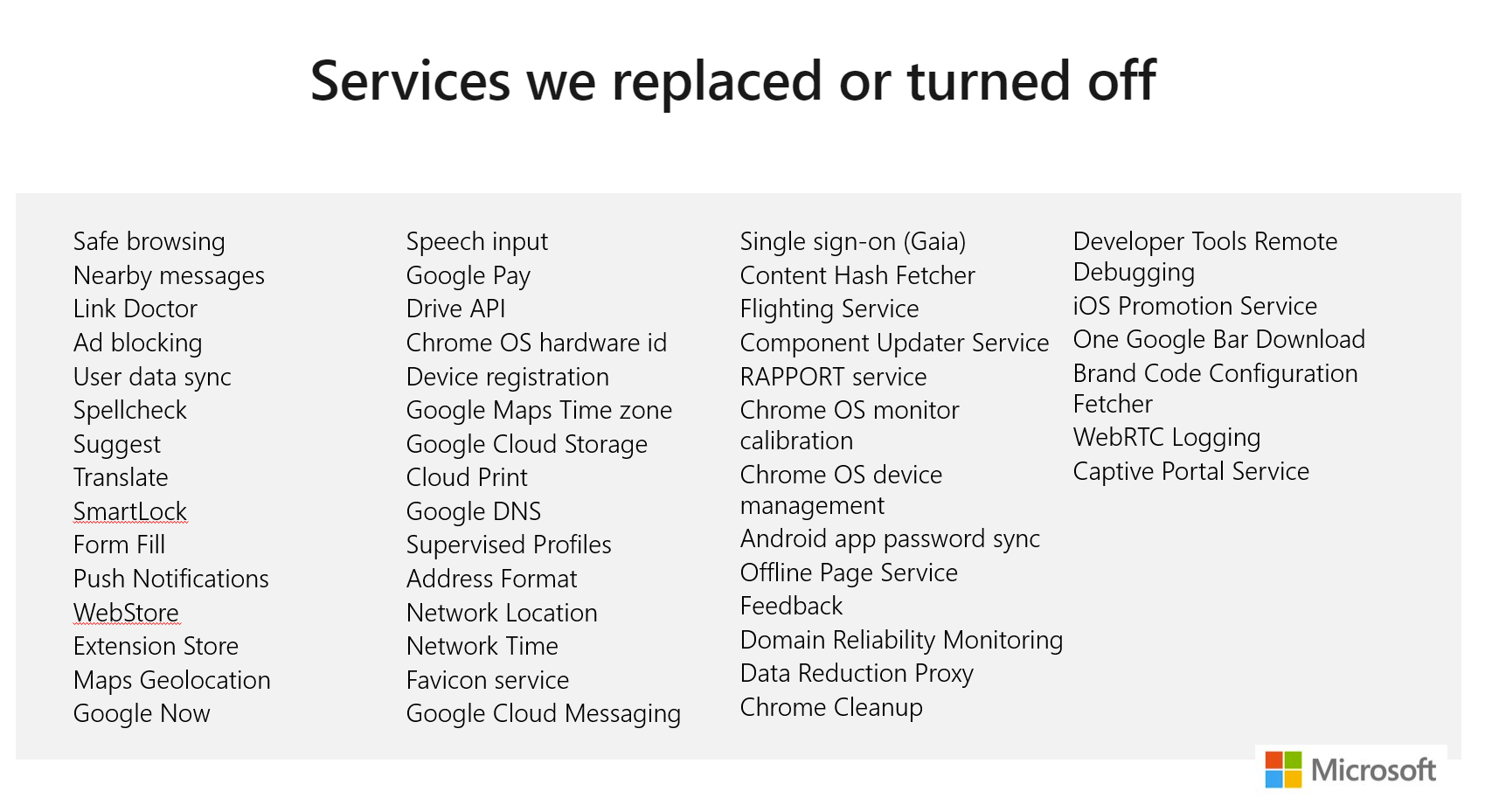
That suggests all this stuff is actually in Chromium, not added later to Chrome in some additional process. That means if you wanna build your own Chromium fork and de-couple yourself from Google, you’ve got some work to do.
Several big players have done that work. Clearly, Microsoft has done it with Edge. Vivaldi and Brave are other big Chromium-based browsers with presumably similar de-Googleification.
Dan Abramov was asking around about this the other day:
Sounds like Dan (and by extension: me) learned through this thread that Chromium isn’t actually just the core browser stuff where Chrome then adds stuff on top of it. It’s that if you want to base another browser on Chromium, you have to yank stuff out of Chromium.
Seems a smidge weird to me, but hey, it’s open-source, so if you don’t like it, fork it. And obviously many have. Perhaps most notable is ungoogled-chromium. It lists this as the philosophy:
- Remove all remaining background requests to any web services while building and running the browser
- Remove all code specific to Google web services
- Remove all uses of pre-made binaries from the source code, and replace them with user-provided alternatives when possible.
- Disable features that inhibit control and transparency, and add or modify features that promote them (these changes will almost always require manual activation or enabling).
I have zero doubt that the browser world is converging on Chromium. You can imagine Apple hanging onto their own thing with WebKit forever, but things don’t seem to be going terribly well at Mozilla, and they haven’t for a while. Mozilla’s money seems to come from Google anyway so it’s tough to imagine Mozilla’s browser engines hanging on for that much longer. Y’all can call me an ignorant asshole in January 2032 if Mozilla still has a competitive browser engine.
The health of the browser ecosystem would benefit from a cleaner, company-agnostic version of Chromium (and maybe call it something else). If most browsers are based on it, so be it, but let the innovation happen from a level playing field.