AI gets its knowledge from three distinct layers: training data, retrieval systems, and live tool access like APIs and MCPs.
Each data layer has its own pros and cons, so if you’ve ever wondered why an AI confidently told you something wrong, why one tool seems to know about last week’s news and another doesn’t, or why your competitor’s product gets mentioned tons while yours doesn’t, the answer almost always traces back to which layer answered your question.[/intro_text]
This article is a plain-English explanation of where AI knowledge actually comes from—and why that matters for how much you should trust any given response.
The global market for AI training datasets was $3.2 billion in 2025, and it’s projected to hit $16.3 billion by 2033—a 22.6% annual growth rate that reflects how central data has become to the whole enterprise.
Here’s the critical thing to understand: once training ends, the model’s knowledge is frozen. It can’t learn from new events. It has no idea what happened yesterday, or last month, or after whatever date its training data was cut off.
Some providers periodically fine-tune their models on newer data, but that’s still a discrete process—more like issuing a software update than continuously reading the news.
The other major failure mode is hallucination. When a model doesn’t have reliable training data to draw on, it fills the gap with something plausible-sounding—a fabricated citation, a made-up statistic, a confident non-answer (like Google’s AI Overview citing an April Fool’s satire article as a factual source).
The model had no way to know the article was a joke; it just looked authoritative enough to fit the pattern.
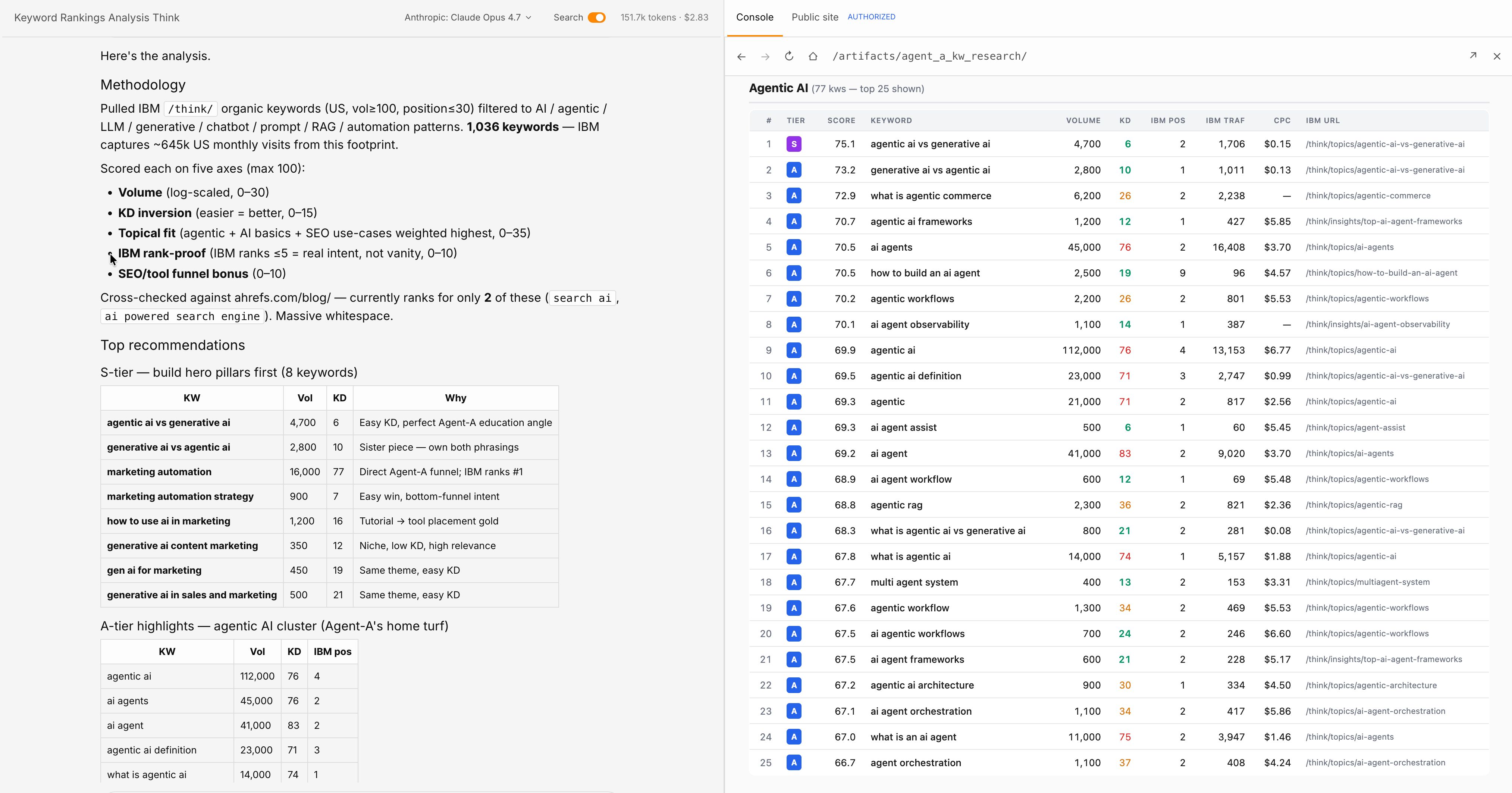
A concrete example: Ahrefs has an MCP integration that lets AI agents query Ahrefs data directly during a task, pulling keyword metrics, backlink data, or competitive insights without the user leaving their workflow.
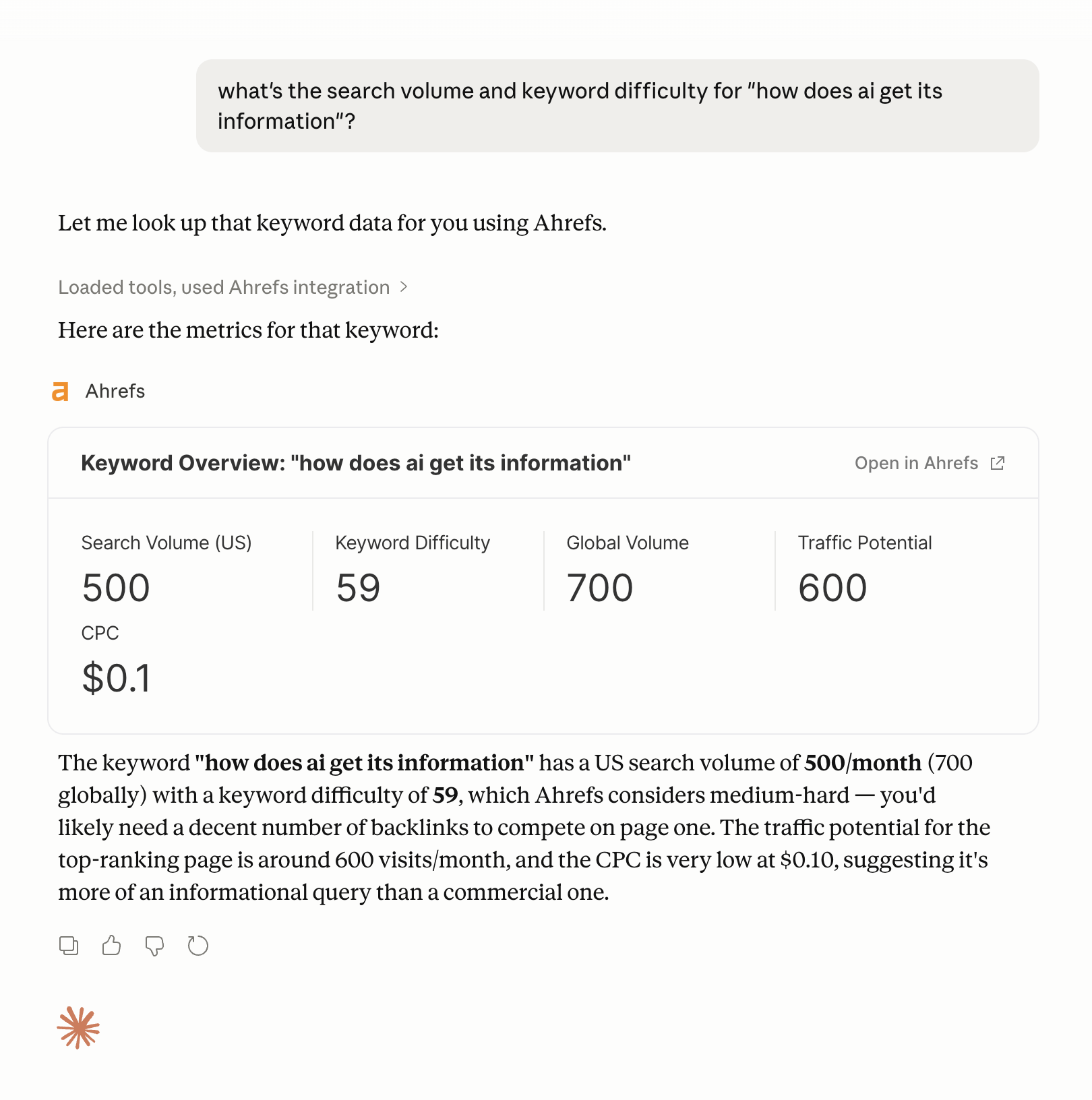
An example of getting keyword data using the Ahrefs MCP in Claude.
Try Agent A now
Ahrefs’ Agent A takes this further. It’s a marketing AI with direct, unlimited access to Ahrefs’ full internal dataset: keyword data, site metrics, competitive intelligence, the works.
Rather than an AI that has to approximate SEO insights from training data (which goes stale) or retrieve them from public sources (which are incomplete), Agent A works from the actual data.
For marketing and SEO tasks specifically, that’s a huge difference: Agent A can tackle many SEO and marketing workflows, without any hand-holding.
The broader principle is that tool-augmented AI is only as reliable as the tools it calls. If the API returns bad data, the AI produces a bad answer, confidently. The intelligence of the model doesn’t save you from garbage inputs. What it does do is extend the model’s reach far beyond what any training dataset could cover.
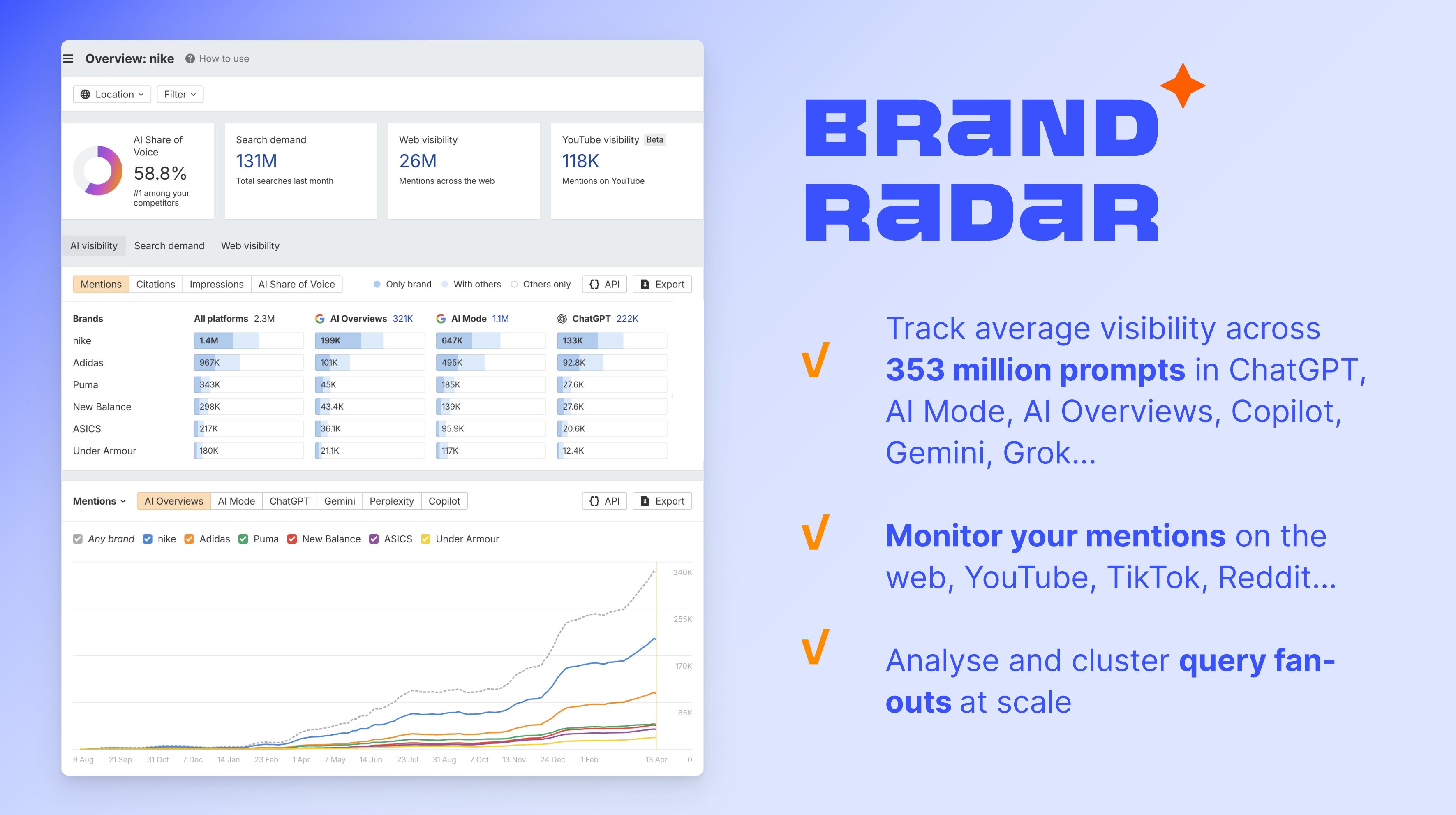
Start tracking AI visibility with Brand Radar
To measure how this is working in practice, Ahrefs’ Brand Radar tracks AI share of voice across ChatGPT, Gemini, Perplexity, AI Overviews, AI Model Grok, and many more, showing how often your brand is mentioned in AI-generated responses relative to competitors. Read this article to learn how it works.
Final thoughts
AI knowledge comes from three layers: frozen training data, retrieved live documents, and connected external tools, like APIs and MCPs. Each has a different accuracy profile, a different relationship with recency, and a different way of failing.
Training data is the foundation—vast, expensive, and static. RAG and grounding add currency at the cost of retrieval reliability. Tool integrations like Ahrefs’ MCP and purpose-built agents like Agent A extend that further, giving AI access to live, authoritative data at the moment it’s needed.
For a deeper look at how AI search engines stitch these layers together to generate answers, check out our guide to how AI search engines work.
Further reading